 SportShooting
Shot Group Analysis
Shot Group Analysis: What a Good Group Is and How Beginners and Elite Shooters Differ
Your score tells you how many points you shot. Your shot group tells you how you shot them. Three measurements describe a group well: how far apart the shots are, how far they sit from their own centre, and where that centre lies on the target. This guide also shows what good and bad look like, and what separates a beginner from an Olympic shooter.
Group size and group position are different problems
A group can be tight and still off-centre, or centred and still wide. The first is a position problem: the shots agree with each other but not with the middle of the target. The second is a consistency problem: the average is right, but the individual shots scatter. Looking at both separately tells you what to work on, and a score alone cannot do that.
This split matters because the two problems have different fixes. A position problem can be corrected by moving the sights. A size problem can only be corrected by technique: stance, grip, hold and trigger release. Experienced shooters therefore think group first, centre second. Nothing is gained by chasing the centre while the group is still wide.
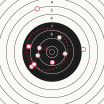
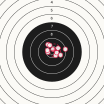
Illustration of ten simulated shots on a 10m air pistol target at the same scale. The holes are drawn to the real 4.5 mm size, not photographed. The dashed circle is the mean radius around the group centre (the cross).
Extreme spread
Measure the two shots that are farthest apart. This is quick to do on paper, and it is the number most people quote. Its weakness is that it depends on only two shots: one stray shot in a ten-shot series can double it while the other nine are tight.
Mean radius
Find the centre of the group, measure each shot's distance to it, and average those distances. Every shot contributes, so one flyer moves the result only a little. This is why mean radius is a better number for comparing one session with another, and why the Progress tab in SportShooting charts the average shot spread over the last 30 days.
Group centre and offset
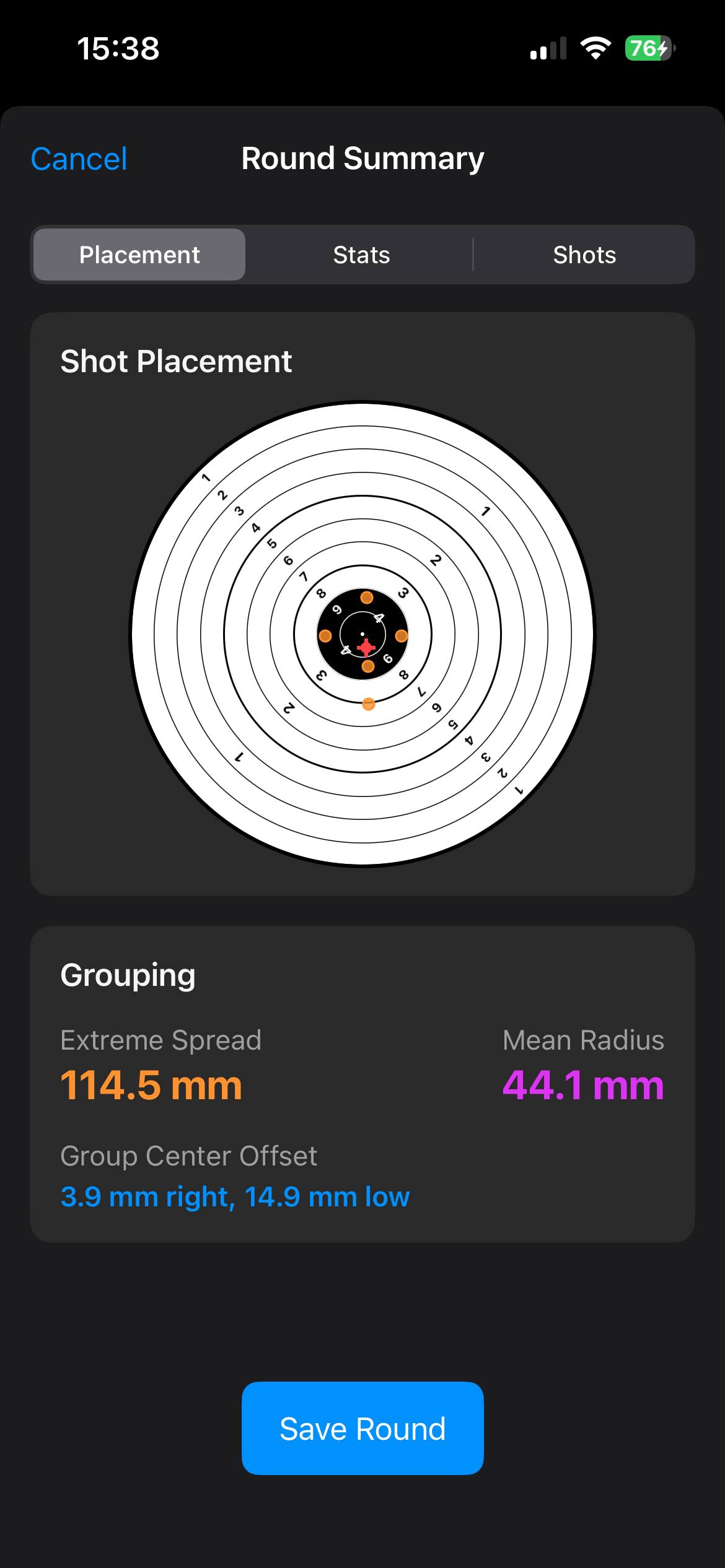
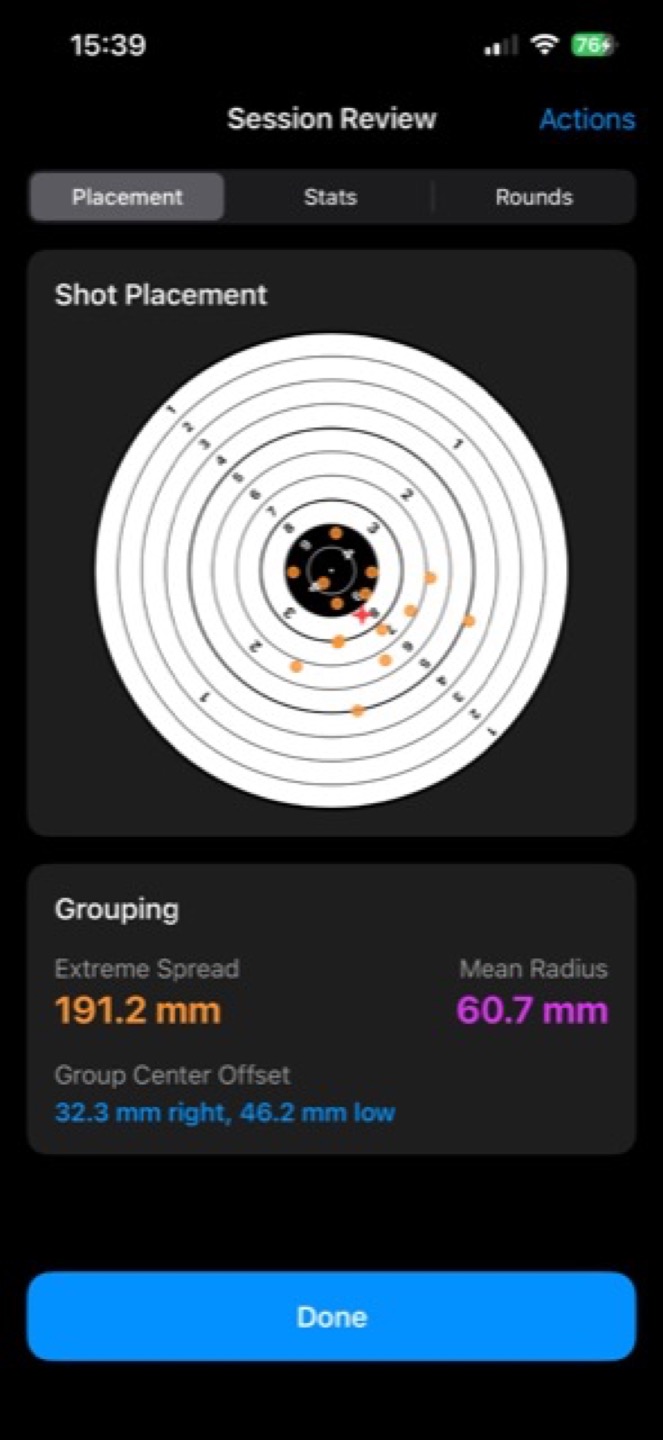
The group centre is the average position of all your shots. How far it lies from the target centre, and in which direction, shows a systematic offset. If a tight group keeps landing in the same place, an offset like that is what you would look for. Whether the cause is the sights, your grip or your hold is something you or your coach need to determine at the range. The measurement only shows that it is there.
What a good group looks like
There is no single good group size, because it depends on the target. A useful way to judge a group is to compare it with the rings. On a 10m air pistol target, the 10 ring is 11.5 mm across and a 4.5 mm hole needs its centre within 8 mm of the middle to score a 10. A group that is much wider than the 9 ring (27.5 mm) cannot produce many tens, however well it is centred.
The table below turns the average score per shot into an approximate mean radius, assuming the group is centred. All figures are for 10m air pistol: 10 m distance, a 4.5 mm pellet, one hand. It is a back-of-the-envelope estimate derived from the ring sizes, not a measured study, and your own numbers will vary.
| Level (10m air pistol) | Average score per shot | Approx. mean radius at 10 m | What it looks like |
|---|---|---|---|
| Newcomer | about 8.0 | about 20 mm | Large scatter, and the centre moves from series to series. |
| Club competitor | about 9.0 | about 12 mm | A recognisable group, usually inside the 9 ring. |
| International level | 9.7 and up | about 5 to 8 mm | Most shots score a 10. The group is tight enough that a small centre offset decides the ring. |
The same score means a different group at a different distance. At 50 m the rings are three times wider, so a 9.5 average score per shot (570 of 600, world class in 50m pistol) corresponds to a mean radius of about 25 mm. That is bigger than any 10 m figure in the table, yet at 10 m the same hold would give about 5 mm, against about 8 mm for a 9.5 average on air pistol. See the 25m and 50m comparison for the full table.
Beginner groups versus elite groups
A beginner's group
- Large, round scatter with no clear cluster
- The centre moves from one series to the next
- Occasional flyers, often from snatching the trigger
- Drift in later series as the arm tires
An elite shooter's group
- A small group that is nearly the same size every series
- The centre barely moves, so a sight click is enough to fix a small offset
- Flyers are rare and get analysed individually
- The last series looks like the first
A large part of the gap between the two is consistency. Elite shooters repeat the same hold and trigger release every shot, so their groups stay stable over a 60-shot match. A beginner can see the same thing on paper: if the group is large but the centre is stable, work on the hold. If the centre keeps wandering, work on repeating your position.
Reading patterns across series
Four patterns cover most of what you will see. The right-hand column is a starting point for a conversation with your coach, not a diagnosis.
| Pattern | First thing to try |
|---|---|
| Tight and off-centre | Technique is consistent, so the sights are the likely cause. Adjust the sights, then log the change. |
| Wide and centred | The average is right, the hold or trigger release is not. Work on stability, not on the sights. |
| Tight and centred | This is what you want. Keep the routine and extend the series length. |
| Centre moves between series | Something changes during the match: grip, stance or fatigue. Compare the first and last series, and ask your coach. |
Why it matters in competition
At international level, qualification is decided on whole rings, but the final is scored in tenths. One shot at the edge of the 10 ring can be worth 10.0 or 10.9 points, so a small group shift matters. At that level, the group is almost entirely a question of consistency, and shooters track it every training session.
The three measures at a glance
| Measure | What it is | What it tells you |
|---|---|---|
| Extreme spread | Largest distance between any two shots | Overall size, sensitive to single flyers |
| Mean radius | Average distance from the group centre | How tight the group is, using every shot |
| Group centre | Average position of all shots | Whether and in which direction the group is off-centre |
How to track groups over time
- Always compare the same target and distance. A group measured at 10 m is not comparable to one at 25 m.
- Use a consistent series length, for example ten shots, so that groups are comparable.
- Record spread and score together. If the score rises while the spread stays the same, the improvement came from centring, not from tightening.
- Look at several sessions before drawing conclusions. A single series is noisy.
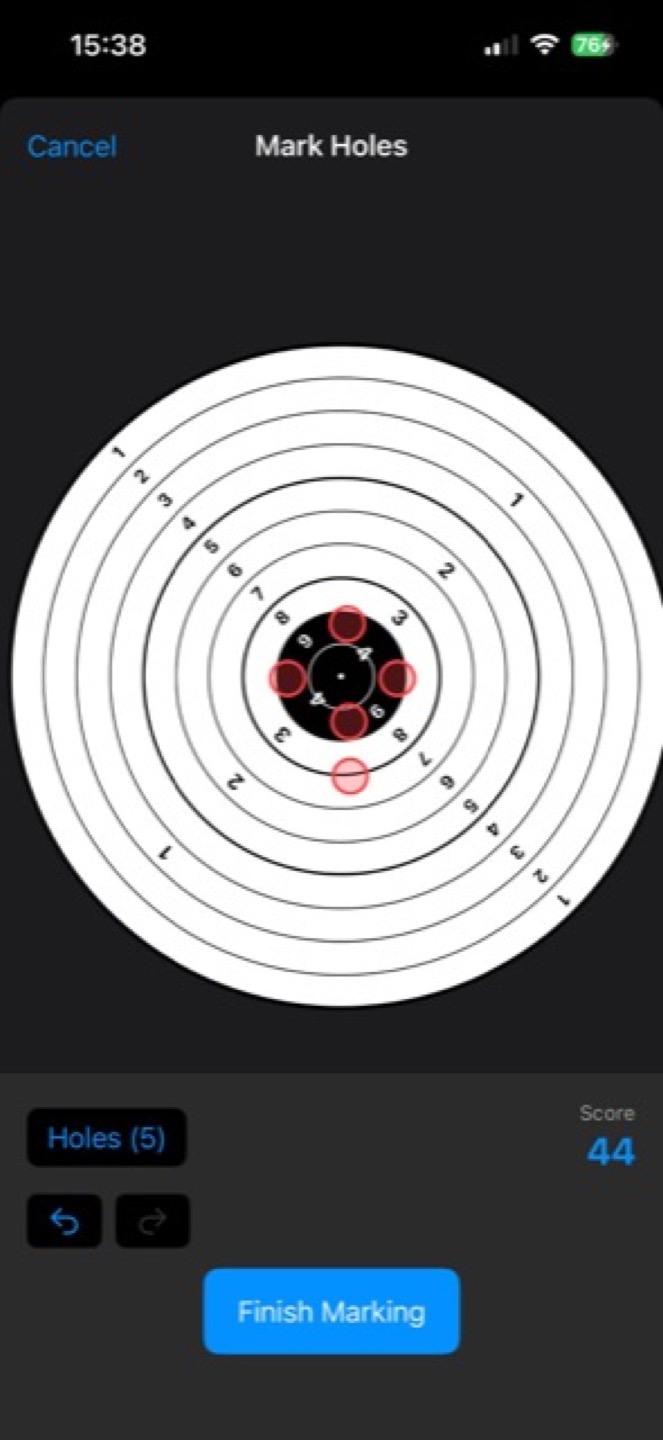
SportShooting does the calculation after you mark the shots and keeps each round in your session history, so earlier groups on the same target and distance are easy to find. Marking is done on a drawn replica of the target; positions are therefore relative to the target's rings. For how scoring works on an air pistol target, see 10m air pistol scoring.
See your groups, not just your score
Mark your shots and get extreme spread, mean radius and group centre for every round.
Download on the App StoreFrequently asked questions
What is extreme spread?
Extreme spread is the largest distance between any two shots in a group. It is simple to measure, but a single stray shot can change it a lot.
What is mean radius?
Mean radius is the average distance of the shots from the centre of the group. Because it uses every shot, it is steadier than extreme spread when you compare sessions.
What is the group centre offset?
The group centre is the average position of all shots. Its offset from the middle of the target shows whether your group sits systematically to one side, independent of how tight it is.
What is a good group size for 10m air pistol?
On a 10m air pistol target, a club shooter averaging about 9 points per shot typically has a mean radius of roughly 12 mm, and an international-level shooter averaging 9.7 or more roughly 5 to 8 mm. These are estimates derived from ring sizes, not measured studies.
Why does my group move between series?
A group whose centre changes during a match points to something that changes over time, such as grip, stance or fatigue. Beginners usually show this clearly, while elite shooters keep their centre very stable from series to series.
How big is a good group at 50 m?
At 50 m a 9.5 average score per shot (570 of 600, regarded as world class in 50m pistol) corresponds to a mean radius of roughly 25 mm (1 in) on the 50 mm ten ring face. That is a bigger group than at 10 m, but it is like a 5 mm miss at 10 m, so it is harder to shoot. This is an estimate derived from ring sizes.
Does SportShooting calculate these automatically?
Yes. After you mark the shots, the app calculates extreme spread, mean radius and group centre for the round, and shows trends of average shot score and spread on the Progress tab.
Related: air pistol training log, digital shooting logbook, and all guides.